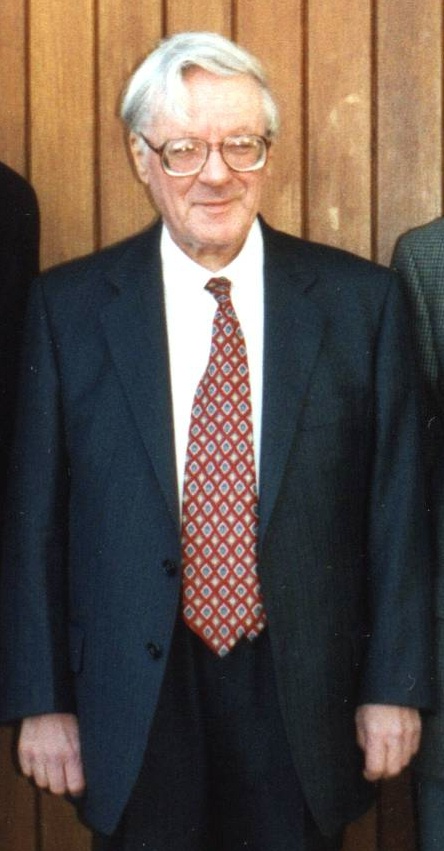
On Thursday May 12th Dr Kenneth Dix passed into the presence of his Saviour. The interment and Thanksgiving Service is to be held on the coming Monday, May 23rd. The following remarks are what I remember of him and I cannot be sure that my memory is accurate in every detail; I add this now rather than pepper what I say with ‘I believe’ or words to that effect. He was brought up in Ivinghoe, Bucks, in the shadow of the Chilterns and Ivinghoe Beacon. His father was deacon at the Strict Baptist Chapel in the village, and visiting preachers often spent the Lord’s Day in the Dix home. In spite of that he did not understand the proper meaning of ‘Strict and Particular’ until he became an adult. He was a great lover of classical music and J.S. Bach’s ‘St John Passion’ was a determining factor in his conversion. He had a rather whimsical sense of humour and he enjoyed telling me that just before his wedding he received a postcard from a pastor with the cryptic message: ‘Take courage, brother, and don’t be late’! His wife, Jane, was a proficient artist and when he began to give slide presentations of important figures of Christian history it was she who provided the art work. Sadly, she has been an invalid for some years.
He attended evening classes at LondonBibleCollege and received the Religious Knowledge Diploma in 1961. He greatly appreciated the lectures of Dr Ernest Kevan and still kept the notes he had taken, at least until a year or two ago. For some years he worked for the Trinitarian Bible Society. He had three pastorates, the last of 14 years at DunstableBaptistChurch. There were 12 members when he was called, but 2 left on his arrival. By the time he retired, by the grace of God membership was in the 60’s. I remember hearing his name quite often during his TBS days, but he seemed to drop off the map when he went to Dunstable. He gave himself to the work of the local church.
He was always interested in history and few others have such a knowledge of the Strict Baptists; he was involved in the Strict Baptist Historical Society right up to his death. However, he also read a great deal by secular historians so that he could place his Christian history in the wider ethos of the times. His PhD, gained in retirement, came from KeeleUniversity, though he started out with the intention of doing an MPhil. It was published as ‘Strict and Particular’ by the Baptist Historical Society. He was a quiet, gracious man of God and I thank the Lord for memory of him.
I recently finished reading ‘The Ulster Awakening’ by John Weir (BoT). I read short extracts prior to reading the Scriptures to help me get into a suitable frame of mind. I have read other accounts of the same time of revival in 1859, but this one is very thorough with extensive quotations from ministers involved in the events that took place. Several points caught my attention. Firstly, while there was great conviction often followed by great joy, the overall impression of the meetings seems to have been one of solemnity; a holy reverence seems to have been the atmosphere of the revival. I cannot help feeling that this is becoming more and more a missing note in our worship. Secondly, the final chapter is on the urgent need of revival in Great Britain. The author refers to statistics which seem to show that just under 50% of the population attended church at that time. He considered this a very serious matter. What would he make of the situation today? How is it we can be so unmoved about the present spiritual condition of our country? Finally, this book shows what God is able to do and has done in the past. Yet the emphasis on revival, and prayer for revival, does not seem to have the profile which once it did. Can anything else adequately meet our current need?
Wednesday, 4 May 2011
I have just finished reading The Faith Once Entrusted to the Saints? by Geoffrey Grogan (IVP). Grogan celebrated his 85th birthday a month or two ago after nearly 60 years of teaching, mainly in London Bible College and what is now the International Christian College in Glasgow. It looks to me as if he has put his heart into this volume, certainly his gracious, balanced character shines out of the book. Here is someone contending for the faith who is also wise and understanding. It may be that he could have expressed himself more strongly in places, some of us would have done so, but I think his concern is to win over those who disagree and to help and steady those who have been unsettled by the winds of doctrine blowing through evangelicalism. His three chapters on Open Theism, Penal Substitution and the New Perspective on Paul are first-rate; and I found his discussion of Romans in the latter chapter very helpful. He has a chapter on Scripture and another on Hermeneutics. These chapters are not directed at specific targets in the way the others mentioned are, but there is actually a great deal that is informative and valuable in them, especially for those who would be glad of an overview of modern biblical hermeneutics. They are the fruit of much reading and thought. There is a final chapter entitled Whither Evangelicalism. I loved this sentence as he draws to a conclusion: ‘There are some truths that belong to the circumference of our faith, others that are more central to it, but at its very heart is Christ himself, who has embraced us with his marvellous grace, whom we love, in whom we trust, whose service is our great privilege and our perfect freedom, to whom we give our worship and who will receive that worship to all eternity.’
The recent Leicester Ministers’ Conference hosted by the Banner of Truth does not seem to have much coverage in the blogs this year. One of the talking points has been the reduced attendance this year. I have no more idea of the reason for this than anyone else but I suspect it was a combination of factors. A couple of times I heard people say that this was one of the best conferences, so perhaps numbers will revive next year. I suspect that they will at least be much better than this year’s. One advantage this year was that queues were not so large; also it was easier to find your friends, though I was glad to be able to talk with a number of people I’d never met before. Another advantage was the ‘tabernacle’ in which we had coffee, which had tables and chairs and much more opportunity for relaxing and chatting than in Gilbert Murray Hall.
I only wish to mention three sessions that I found truly outstanding. The first was the opening sermon by Steven Curry on Matthew 6:1-18. This was real preaching: good exposition but seriously and sympathetically applied. It was an excellent beginning. Second was the address by Iain Murray on Archibald Brown. He was more a name than anything else, though I realised I knew that he was pastor at East London Tabernacle when I was reminded of it. He had a truly amazing ministry in London’s East End. I was very struck by hearing that he had hundreds of photos of people of great poverty, and/or, great sinfulness, with notes about them written on the back. He was not just a preacher; he went out among the people, got to know them and their needs, and sought to minister to them in every way he could. His ministry was bathed in congregational prayer. Finally, Phil Arthur gave a masterly address on William Tyndale. One minister from Australia said it would have been worth coming all the way to the Conference just for that alone. As Phil is my pastor my remarks might be taken with a pinch of salt – get a CD and check it out for yourself.
I do not know whether I shall be at next year’s conference; these last two or three years I have found myself completely drained by the end and I was tired out on the Friday after. But I am very glad I made it this year.
A few years ago we answered an ad for a free magnolia tree. We received by post a cardboard box about 2ft long or thereabouts; inside this was a dry stick with an excuse for a root at one end. We duly planted it in a pot and eventually it began to grow and we had leaves for two or three years. But this year it has produced 20 white flowers, though heavy rain these last couple of days has not helped it. I could not help remembering Aaron’s rod that budded, and also Ezekiel 17:24, where we are told that the Lord ‘made the dry tree flourish’ (though I had to look the latter up in a concordance). Spring reminds us of the way God is able to renew the face of the earth and this leads us to consider what he is able to do for the churches. There may be churches where everything seems pretty dry and some ministers appear to be dry old sticks, but the Lord can make them flourish and fruitful.
On Gary Benfold's blog there is a response to a charismatic friend in which Gary has some comments on 1 Corinthians 13:9ff. He mentions Stuart Ollyott's understanding of this passage, though I read it too long ago to remember it in any detail. For me the key is v.10. The NIV translates: 'but when perfection comes, the imperfect disappears.' By using 'imperfect' instead of 'partial' or 'in part' they have decided to use the antonym to 'perfection'. However, it surely ought to be the other way round. The antonym to 'partial' is 'complete'. Why is this word never used? After all, 'perfect' or 'perfection' prejudges the meaning of the phrase. The Greek word is teleion, of which Arndt & Gingrich say: 'having attained the end or purpose, complete, perfect'. The phrase is almost a proverbial or tautological one: 'When the complete comes, the partial has ended' QED. Once the complete prophetic revelation comes, the partial ceases.
Tunisia, Egypt, Libya - who knows how things will yet turn out? I was struck with these words of the poet Robert Southey: 'Few persons but those who lived in it can conceive or comprehend what the memory of the French Revolution was, nor what a visionary world seemed to open upon those who were just entering it. Old things seemed passing away, and nothing was dreamt of but the regeneration of the human race.'
Born of missionary parents, after National Service in the RAF I trained at London Bible College. I was an assistant pastor at Spring Road Evangelical Church, Southampton, pastor at Bethel Evangelical Free Church, Hanley, Stoke-on-Trent, and Dunstable Baptist Church, prior to retiring in 2003.
.jpg)